Bradford Literature Festival’s (BLF) first weekend closed with an event on the legendary Sylvia Plath, as two experts discussed her life in writing. Dr Amanda Golden, Associate Professor of English at New York Institute of Technology and one of the two editors of the recently released The Poems of Sylvia Plath, was joined in conversation by Dr Iona Murphy, a Plath scholar from the University of Huddersfield.
The discussion began with Murphy asking Golden about the project she undertook with her partner, Karen V. Kukil; Golden said, “It began 15 years ago; it’s been a mammoth undertaking.” She added, “Over the last 40 years, a huge number of letters, poems and drawings done by Plath in her lifetime have been discovered. The first task Karen and I had was to catalogue every one.”
They ordered and dated them; Golden said, “It was truly wonderful because Plath wrote many drafts of each poem, and by following them through development it was like reading history.”
Golden then talked about how she started her research in the main archive of Sylvia Plath at Smith College, where Plath studied and was later invited back to teach. Golden said, “The archive begins the with manuscripts Plath sold when she was alive (almost all of her poems were published posthumously). One of the most interesting pieces in there is Plath’s dictionary; not only did she underline numerous words, but what was really interesting was that she’d pressed a four-leafed clover between the pages.”
Murphy then asked Golden why she took on the project, and Golden’s simple answer brought laughter and agreement from the audience: “Who could say no?”
When asked what she found difficult, Golden said one of the biggest frustrations was Plath’s erasures. Golden said, “Reading what was written on the multitude of pages was pretty easy. Plath had incredibly legible handwriting; the problem was, when Plath made a mistake or changed something, she scribbled over it. It was difficult trying to make out the erased words and phrases.”
The discussion then moved on to Plath herself. “Why do you think Plath’s legacy is so enduring, compared to that of many of her contemporaries?” Murphy asked. Golden answered, “I think there are many reasons. One of the foremost is that, as more and more of Plath’s writings are discovered – as her body of work becomes much larger – the narrow view that many have previously held of Plath as both a person and a writer is being hugely widened.
“Thanks to the multitude of recent discoveries, Plath is no longer pigeonholed as someone who simply wrote about nature or mental health. The scope of her body of work is much wider than this.” Indeed, Golden said one of the things she loves most about researching Plath is that she’s constantly finding new themes in her work.
Golden then spoke a little about her love for poetry in general. “One of the things that makes poetry so important is that there’s no right answer. But this can make poetry very intimidating too!” Golden added, to laughs from the audience. Golden talked about how people are taught to read in different ways, but also have a variety of experiences, and the way one person reads a poem is not necessarily the same way in which another person does.
Before moving to the Q&A, which involved a lot of very interesting and detailed questions form a very engaged audience, Golden added one final fact; Plath wrote a single novel in her life, The Bell Jar; Golden revealed that Plath studied botany at Smith College and indeed, spent a lot of time with bell jars.
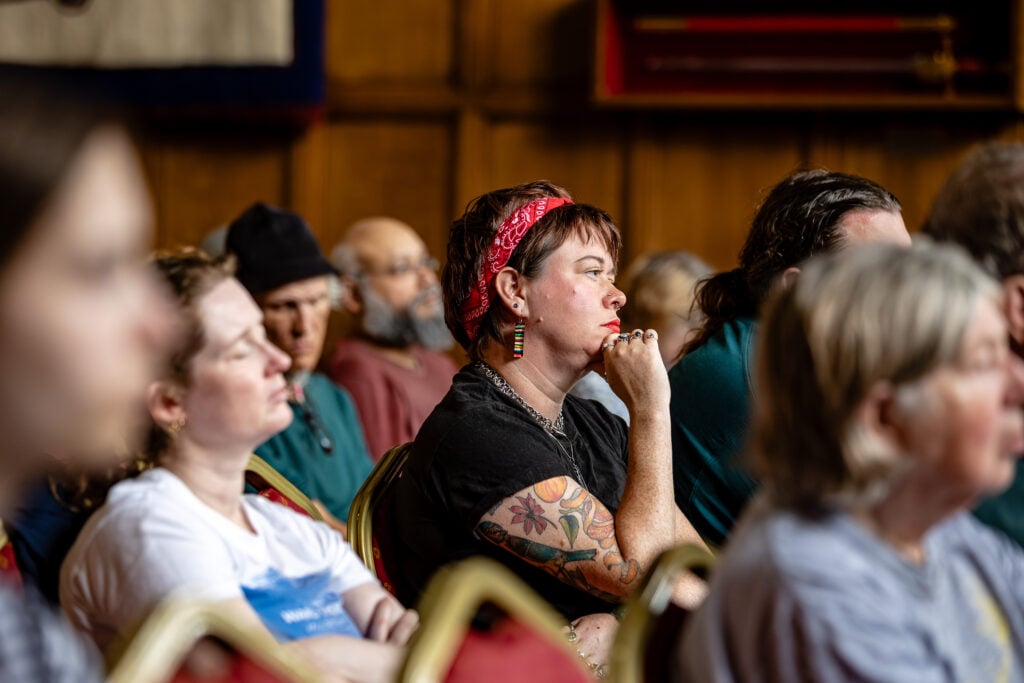
The event brought the first weekend of Bradford Literature Festival to a close on a high, with the audience leaving in a thrum of conversation. Golden then headed over to the festival hub to meet the audience and sign copies of the book she co-edited.