In its opening weekend, the twelfth annual Bradford Literature Festival demonstrated its talent for eclectic and inclusive cultural programming with sold out events and audiences from across the UK and internationally.
Continuing its established reputation for challenging discussions from a balanced, historical perspective, building bridges across communities, and hosting topical talks as well as walking tours and family events, BLF’s 2026 opening weekend had something for everyone.
Commenting on the opening weekend and ethos behind Bradford Literature Festival, Founder and Artistic Director Syima Aslam said: “Culture is not a luxury. It is a necessity. Bradford Literature Festival began with a simple idea: that a literature festival in this city should be more than a series of events. It should be a place of encounter. A place of ambition. A place where people who are too often spoken about could speak for themselves. A place where stories that had lived for generations in families, in communities, in music, in poetry, in memory, and in silence, could be brought into the centre of cultural life. We are very purposefully a literature festival, even though our programme is across arts, music, theatre, film and visual art. We are a literature festival because literature is not narrow. Literature is language, imagination, memory, argument, beauty and truth. Literature is how we understand ourselves, and how we begin to understand each other.”
BLF’s hugely popular, annual comedy night opened the festival on the Friday night, with a stellar line-up including Taskmaster’s Desiree Burch, local star Jack Carroll of Britain’s Got Talent fame, and the fearless and charismatic Ola Labib, hosted by Eshaan Akbar.
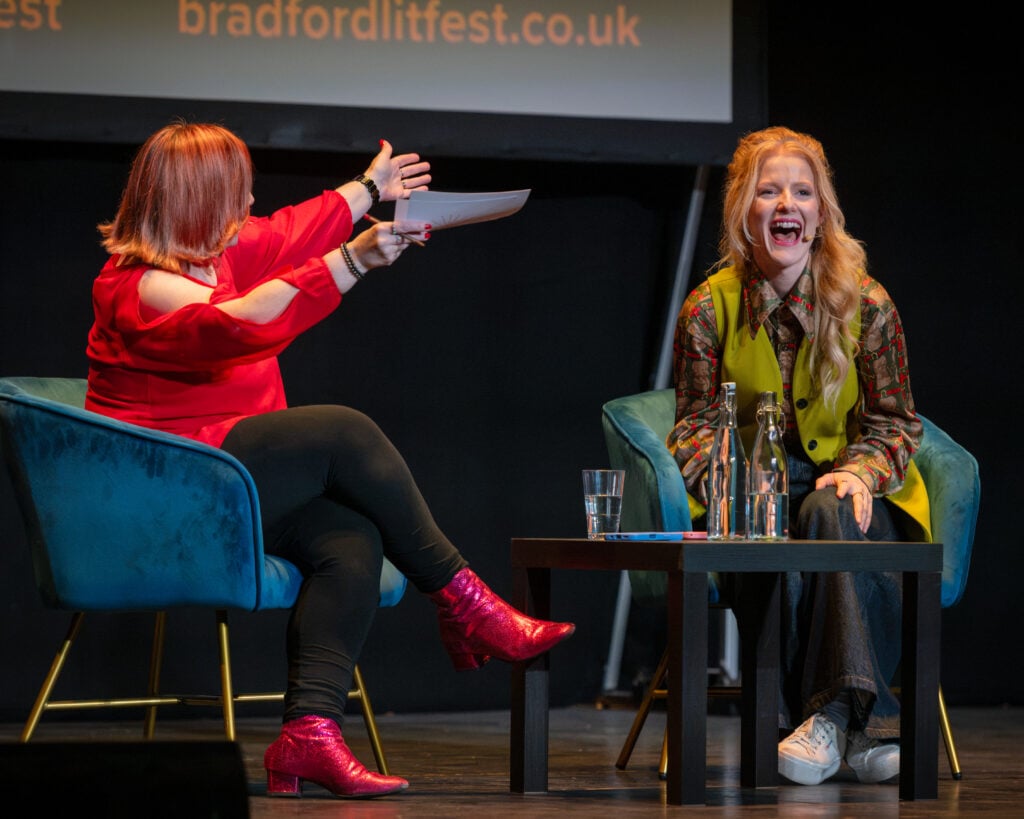
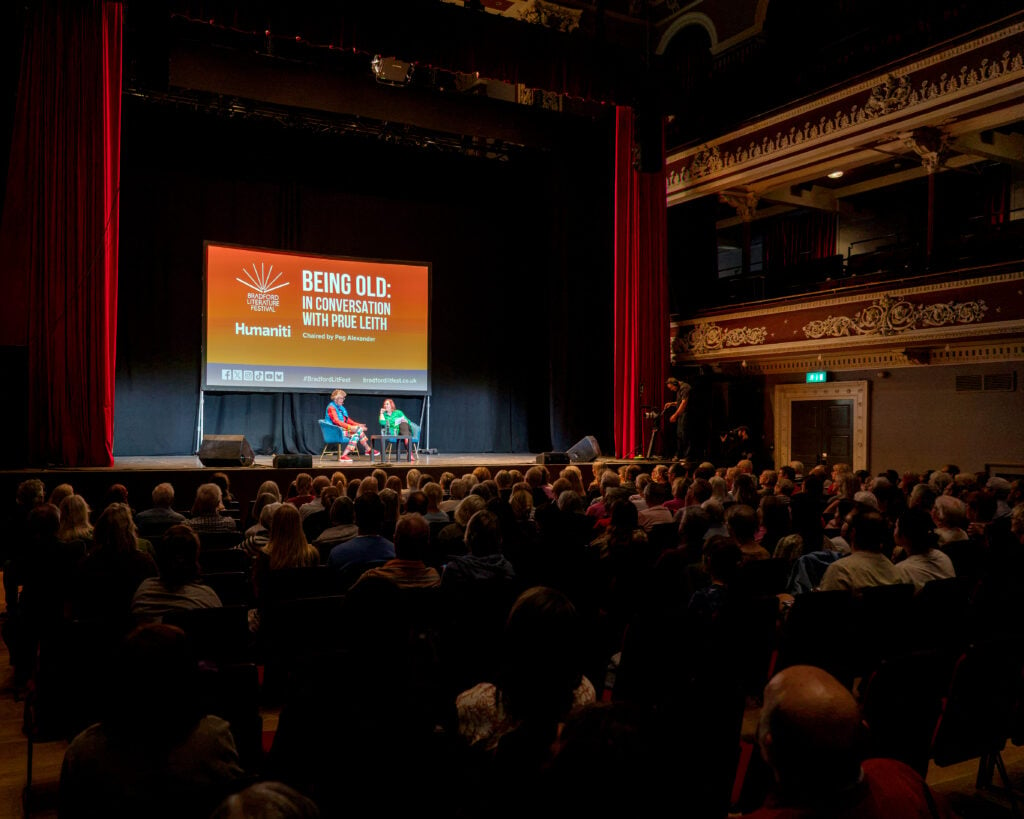
The festival’s spirit of community and kindness was echoed in headline events with David Larbi, Prue Leith and Hannah Spencer, who united audiences in humour and humanitarianism. In an inspiring talk on growing up with autism, Heartstopper star Bradley Riches spoke about being non-verbal until the age of 10. It wasn’t until he found the arts, and drama specifically, that he was able to communicate with people, through playing and mimicking characters.
Using art to communicate was also key for Guardian critic and author John Harris, who spoke about his son James’ autism and their shared love of music: “It doesn’t feel like a conversation when you’re playing music with someone, it is a conversation. It serves as a language for communicating how you’re feeling.”
Using art as a form of communication and expression was a thread throughout the festival, with musicians and writers John Robb and Dave Randall discussing the power of music as a form of protest and collective action, highlighting the success of campaigns such as Rock Against Racism.
Photographer and filmmaker Misan Harriman gave the festival’s annual Free Word Lecture to close the Sunday evening. Charting the story of the career, starting out as a street photographer documenting the Black Lives Matter movement, Harriman gave a stunningly moving talk on the importance of protest, and the power of photography to present a mirror to truth. There will be a screening of Misan Harriman’s new film Shoot the People, a documentary capturing his journey photographing global protest movements, at the festival on Friday 10th July.
The relationship between democracy, technology and power featured in many of the festival’s events on geopolitics. Ebrahim Rasool, the Former South African Ambassador to the United States, debated with podcaster and journalist Myriam François in a wide-ranging conversation on the state of democracy in 2026. Expressing concerns over the influence global tech companies have, Rasool argued: “We are living in an age of democracy defined by its lowest common denominator: we have elections, but that’s it.” François echoed Rasool’s concerns, who saw the rise of social media as a political tool a significant turning point in global democracy.
Appearing for a third time at the festival, Husam Zomlot, the Palestinian Ambassador to the UK, spoke on the Friday evening with Humza Yousaf, the former First Minister of Scotland, about his childhood growing up in a refugee camp. He described it as not only a place of hardship but also “the definition of communal living.” Discussing Sir Keir Starmer’s legacy, Zomlot acknowledged he would “be remembered as the man who recognised the state of Palestine,” but also recognised the reasons behind his resignation.
Politics was popular across the weekend, with Green Party MP Hannah Spencer bringing the house down with a funny and frank conversation about her life in politics to date. Since being elected in February 2026, Spencer has made a point of highlighting out-of-date practices in Parliament. At the festival she spoke out about MPs having separate jobs: “Some ministers have 10 other jobs listed. How can they be serving their constituencies?”
Marking the 250th anniversary of the United States’ Declaration of Independence, authors and academics Saeed Khan, Zahed Amanullah, Nabeela Rasheed and Melissa Butcher explored the origins of modern America and the country’s evolving role within the international order over the past century.
Historians Marc David Baer and Peter Oborne’s delivered a vital, thought-provoking discussion on Baer’s book Children of Abraham: The Story of Jewish-Muslim Relations. The pair discussed the need for all faiths to come together against the rise of the far-right, highlighting the many historic periods of peaceful cohabitation between faiths.
Concerns around online subcultures connected to the ‘manosphere’ were also debated across the festival, with a key event delivered by author Kasim Ali and lecturer Dr Elizabeth Pearson. Ali highlighted the role of global social media companies in the spread of misinformation, outlining how algorithm’s target young men. Dr Pearson was supportive of the move to ban social media for under 16-year-olds, arguing that although “tech companies need to take responsibility, and yes, we need better role models, we also need to introduce a society-wide ban on social media, as we have done with film and television.” Ali noted how this was also a class issue, and that parents working longer hours on lower incomes have less capacity to monitor their children’s online usage.
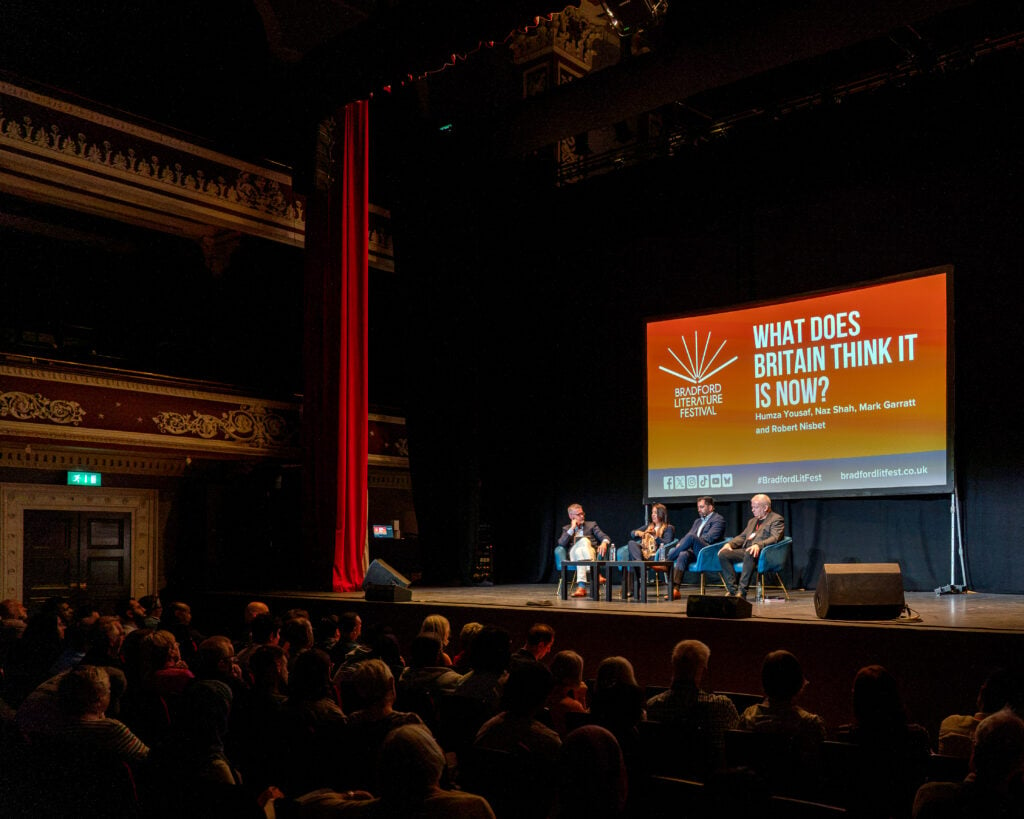
There was no shortage of engaging events on literature, with an illuminating lecture inside the mind of William Blake by Mark Vernon, which delved into Blake’s understanding of consciousness, vision and the human spirit. Marking the 50th anniversary of Agatha’s Christie’s passing, three of UK’s leading crime writers, Janice Hallett, Hazell Ward and Tom Hindle, came together to celebrate the woman who made the whodunnit an art form.
Braford’s own A.A. Dhand also launched his new crime novel The Kingpin at the festival. The follow up to his Sunday Times bestseller The Chemist, Dhand spoke with fellow crime writer Abir Mukherjee about writing 1.1 million words before being published, and drawing inspiration from his time working as an actual chemist during the Covid-19 pandemic.

Cementing itself as one of the one of the most important cultural celebrations in the North of England, the popular Lyrical Mehfil, an event exploring the beauty and importance of lyrical poetry returned with appearances from the likes of Len Pennie, Hanan Issa, John Siddique and Tigist Mamo Belachew.
As always, BLF’s programme offers more than talks and panels. A wide range of events were open to the public, from exhibitions and heritage walking tours, to live performances, film screenings and family events.
The festival continues until Sunday 12th July. For more information and to book tickets, visit: www.bradfordlitfest.co.uk.